
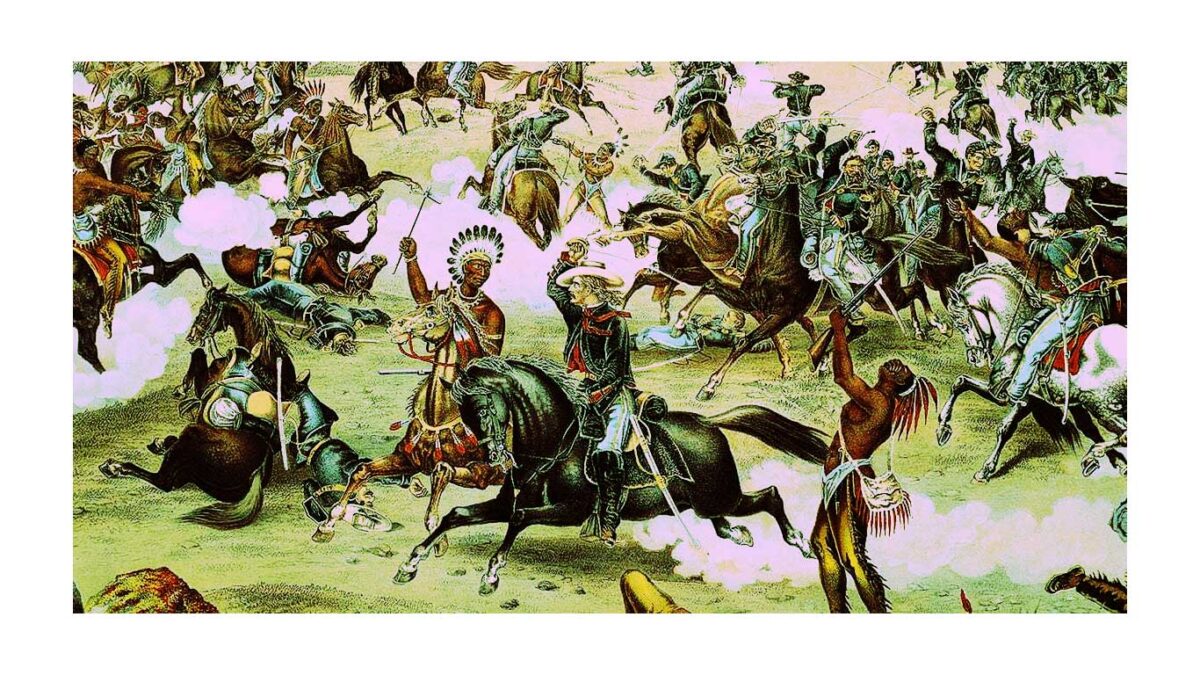
Most of us, as children, played cowboys and Indians at least once, unknowingly reenacting a story of conquest and resistance. Many of us naturally sided with the cowboys—the victorious, heroic figures portrayed in popular culture. As we matured however, some of us began to see the Native Americans not as villains, but as people defending their land and way of life. Instead, some of us clung to the cowboy narrative, failing to recognize the underlying injustices of colonization. This childhood game, though innocent in appearance, mirrors a much older and darker truth that persists even today, most notably in the ongoing Israeli-Palestinian conflict. This divide can even echo the way various political factions approach the narrative, with the majority of Republicans sympathizing more with the “cowboys” and progressive Democrats aligning with the “Indians,” revealing how ideologies shape our understanding of history and current events.
A key parallel between the Native American resistance and the Palestinian struggle is the extreme asymmetry in power. When European settlers moved westward in North America, they did so with the backing of increasingly advanced military resources—rifles, cannons, and organized militias—while indigenous tribes fought back with far more rudimentary weapons like bows, arrows, and spears. By the late 19th century, the U.S. Army had become a force of over 25,000 soldiers, armed with the latest technology of the time, including repeating rifles and artillery. The consequences were devastating—over 90% of the Native American population was wiped out by the end of the Indian Wars, which is estimated to represent about 20 million individuals, either through direct violence, displacement, or disease.
Similarly, today, the Palestinians face the overwhelming might of the Israeli Defense Forces (IDF), one of the world’s most technologically advanced military. The IDF boasts cutting-edge aircraft, tanks, precision-guided munitions, and the Iron Dome missile defense system, supported by billions of dollars in annual military aid from the United States (around $3.8 billion per year as of recent agreements). In contrast, Palestinian militant groups, such as Hamas, rely on far less sophisticated weapons, often homemade rockets, while civilians live under heavy restrictions, with limited access to basic resources like clean water, healthcare, and electricity. In Gaza, for instance, unemployment rates hover around 45%, and around 80% of the population relies on international aid for survival.
The past year has seen a particularly brutal toll in Gaza, with more than 40,000 Palestinian civilians—mostly women, children, and the elderly—killed in a series of escalations and retaliatory strikes, making this one of the deadliest years in recent memory. This overwhelming civilian death toll brings into sharp focus the staggering imbalance in power and resources between the two sides, highlighting that this isn’t just a conflict over territory, but a humanitarian crisis where entire communities are wiped out, and neighborhoods are reduced to rubble in an istant. Yet, international media coverage and diplomatic negotiations often focus disproportionately on Israeli casualties, particularly in discussions about security concerns. Palestinian deaths are frequently dismissed as collateral damage or overshadowed by broader geopolitical narratives. This disparity in the value of life dehumanizes the occupied population, much as it did with the Native Americans during their own fight for survival.
This devaluation of indigenous lives, whether Native American or Palestinian, serves to justify the actions of those in power. Resistance is labeled as violent extremism, while the occupying force is painted as maintaining law and order. Moreover, colonizers often employ their courts and judicial systems to lend a veneer of credibility to their actions, framing their military campaigns as legal and necessary under the guise of governance. In reality, the people resisting occupation—whether on the American plains or in the streets of Gaza—are fighting for their land, their dignity, and their right to exist.
Understanding these conflicts requires us to move beyond ideologies that provide convenient narratives. Just as we have come to recognize the injustices done to Native Americans—through land theft, forced relocations, and ethnic cleansing—we must examine the Palestinian struggle with the same historical lens. The parallels between these two resistance movements are striking not just because of the asymmetry in military power, but because both groups are fighting for the same fundamental rights: the right to live freely on their own land, to preserve their culture, and to secure a future for their children.
History repeats itself not because it is destined to, but because we fail to learn from the past. If we continue to allow power dynamics and the dehumanization of indigenous peoples to dictate our understanding of these conflicts, we perpetuate the same cycle of occupation and resistance. The challenge is to recognize why people resist—to understand their grievances and their humanity. Only then can we hope to break the cycle that has led to such immense suffering, whether on the American frontier or in the contested lands of Palestine.
In both cases, the message is clear: until the rights of the oppressed are fully recognized, the fight for independence and justice will continue, no matter how impossible the struggle may seem. The recent toll in Gaza should be a wake-up call to the world: without a deeper understanding of the imbalance and the profound human cost on the ground, history will continue to repeat itself, and the cycle of violence will persist.
We can certainly list other ongoing conflicts: Ukraine, Yemen, Syria, and Sudan, but the dynamics are still the same, even though the actors are different.